

Here is an uncomfortable truth most L&D teams already know but rarely say out loud.
A completion certificate proves someone sat through a course. It does not prove they learned anything. It does not prove they changed how they work. And it certainly does not prove the organisation got any return on what it spent.
Yet for many companies, the certificate remains the primary evidence that training worked.
This is not a small problem. Organisations globally are investing significant budgets into workforce development, and in many cases, the only measurement happening is whether people clicked through to the end. That gap between training activity and actual learning impact is where most corporate development investment quietly disappears.
For organisations serious about building capability rather than just logging completions, rethinking how learning is measured is not optional. It is the foundation of genuinely effective learning and development solutions.
Why Completion Rates Are the Wrong Metric for Learning Success
Completion rates are easy to track. That is precisely why they became the default measure. But easy is not the same as meaningful.
Think about what a completion rate actually tells you:
What it does not tell you:
This is the measurement gap. And it persists not because organisations do not care about impact, but because measuring real learning outcomes requires more deliberate design than tracking module completions.
The shift toward meaningful measurement starts with asking a different question. Not "Did people complete the training?" but "Did the training change anything that matters?"
The Kirkpatrick Model: Still the Most Practical Framework for Measuring Training Impact
Before exploring newer approaches, it is worth grounding this conversation in the most widely used framework for training evaluation: the Kirkpatrick Model.
Developed in the 1950s and refined over decades, it remains practically relevant because it is structured around what organisations actually need to know.
The four levels are:
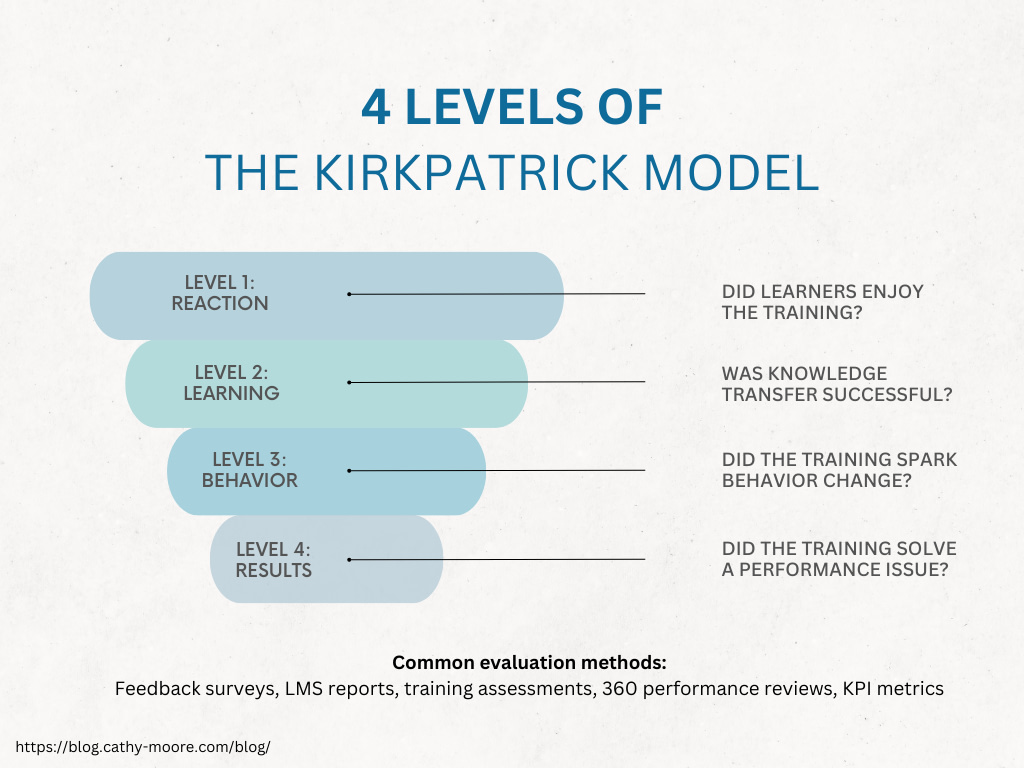
Most organisations measure Level 1 well and Level 4 rarely. The real opportunity lies in building consistent measurement at Levels 2 and 3.
Practical Methods for Measuring Knowledge Transfer After Training
Moving beyond certificates means building measurement into the learning experience itself, not bolting it on as an afterthought.
Practical approaches that work:
The goal is not to add more testing. It is to create touchpoints that reveal whether the learning transferred, and flag early when it has not.
How Managers Play a Critical Role in Measuring Real Learning Impact
This is often the most overlooked piece of the puzzle.
Managers are the closest observers of whether training has changed anything. They see performance daily. They know what good looks like in their team. And yet in most training programs, managers are completely absent from the measurement process.
Building managers into learning measurement means:
When managers are active participants in measurement, the accountability for applying learning shifts from the L&D team alone to the entire line management structure. That shift is significant.
Using Data to Connect Training Investment to Business Outcomes
This is where learning measurement becomes genuinely strategic.
It requires connecting two datasets that most organisations keep completely separate: learning records and performance data.
When those datasets are linked, it becomes possible to ask questions like:
These are not simple correlations to establish. They require intentional data design, cross-functional collaboration between HR, L&D, and business operations, and consistency over time.
But organisations that build this capability stop having to justify training budgets on faith. They can show, with data, what learning is actually producing.
This kind of evidence-based approach is increasingly the standard that sophisticated training strategies and solutions for companies are expected to deliver.
What Effective Learning Measurement Looks Like in Practice
To make this concrete, here is what a well-designed learning measurement approach typically includes:
Before Training:
During Training:
After Training:
This is not a complicated system. It is a deliberate one. And the difference between organisations that can demonstrate learning ROI and those that cannot usually comes down to whether this kind of structure exists.
Why Measuring Learning Impact Also Improves Learning Design
There is a useful side effect of building real measurement into training programs.
When L&D teams know they will be held accountable for behaviour change rather than just completion, they design differently. Courses become shorter and more focused. Content is tested against real job tasks rather than theoretical knowledge. Follow-up resources are built in from the start. Manager touchpoints are planned, not improvised.
Measurement, in other words, does not just evaluate learning. It improves it.
Organisations that embed this thinking into how they build and commission training find that over time, their programs become more targeted, more efficient, and more clearly connected to the outcomes the business actually cares about.
The Bottom Line
A completion certificate is a starting point, not a result.
Organisations that treat it as evidence of learning will keep investing in training without ever being sure it is working. Organisations that build measurement into the design of learning, link it to performance data, and involve managers as active participants in the process will know, with confidence, what their training is actually producing.
That shift from activity measurement to outcome measurement is not just a better use of budget. It is what genuine, effective training strategies and solutions for companies look like in practice.
The certificate tells you the course is done. The only thing that tells you the learning worked is what happens next.
Frequently Asked Questions (FAQs)
Q1: How can organisations move beyond completion certificates to assess real learning?
By integrating learning and development solutions such as pre/post assessments, scenario-based tasks, manager feedback, and follow-ups to measure skill application.
Q2: Why is measuring behaviour change important for corporate training?
It shows whether training has actually improved performance, engagement, and business outcomes, rather than just confirming attendance.
Q3: Can these measurement strategies be used alongside existing training programs?
Yes. Embedding structured assessments and manager touchpoints enhances the effectiveness of any L&D program, online or in-person.
Q4: Do all companies need to measure learning impact this way?
Organisations investing in workforce development or aiming to improve performance metrics benefit the most, as it links training directly to business results.
Q5: Which frameworks are commonly used to measure real learning outcomes?
The Kirkpatrick Model and other evidence-based L&D evaluation frameworks provide structured ways to track knowledge, behaviour, and results.
Written By : Ruchi Mehta





Centre For Training & Professional Development (CTPD) - The Trading brand of TTA Training Private Limited, India is a ISO 9001:2015 Company




© 2021 - Centre For Training & Professional Development (CTPD). All Rights Reserved. Centre For Training & Professional Development (CTPD) trading brand of TTA Training Pvt. Ltd (India) - CIN U80902WB2016PTC215839, Asia Teachers Training Co., Ltd (Thailand) - Registration No. 0105558193360 & Asian College Of Teachers Ltd (UK) - Company Number 9939942 & Asian College Of Teachers LLC, (USA) - Federal Tax Identification Number 30-1261596
Designed by kreativewebtech


